
Chafe Protection for Tug Towlines and Pennants: Covers, Sleeves and How to Choose
Commercial marine / Towage / Chafe protection
A towline rarely fails in the middle of a clean run. It wears out where it touches steel. This guide covers where chafe happens on tugs and commercial vessels, the main types of chafe cover, how to choose one, and how to fit and inspect it.
Guidance drawn from OCIMF STAG [1] and our product data [2]. See references.
Why does chafe matter on a towline?
Ships’ chocks, fairleads and bitts are often pitted, scored and rusted, and the rope that bears on them takes the damage.[3] OCIMF’s STAG says the pennant, because it runs through a fairlead, is more likely to suffer wear and mechanical damage than other components, and that rough surfaces will significantly speed up abrasion.[1]
That is why a chafe cover is a sacrificial part: it takes the wear so the load-bearing rope does not. We cover chafe as a specification point in towing pennants in tug operations. This post goes a level deeper, into the covers themselves.
Where does chafe happen on tugs and commercial vessels?
| Location | What causes the wear | What to protect |
|---|---|---|
| Ship’s fairlead or chock | Rope bears on rough, pitted steel under load and movement | The pennant, in the contact zone |
| Bitts and rollers | Sliding or bending contact, often with a tight radius | The section that sits on the bitt or roller |
| Eyes | Rubbing on the bitt, shackle or cow-hitch | The eye itself, before cow-hitching |
| Tug fairlead, staple or roller | Repeated contact as the towline leads at changing angles | The towline where it passes through |
| Winch drum and level-wind | Cross-over, pinch points and rubbing on the drum edge | Winch line, where contact is concentrated |
| Deck edges and hatch coamings | Dragging or sliding of a slack line | Any section lying on a sharp edge |
STAG recommends always providing chafe protection on the individual eyes before cow-hitching, and states that any synthetic pennant should be protected against chafing.[1]
What types of chafe protection are there?
- Braided tubular sleeves. A sleeve slides over the rope and covers the wear zone. Materials include HMPE, nylon and polyester. Choose by contact surface, load and what the cover has to survive.
- Hide or leather wraps. A traditional cover, often stitched around the rope at a chock or bitt.
- Hose or split-tube covers. Simple and quick to fit; the cover can migrate along the rope, so secure it.
- Spliced-in covers. A sleeve terminated into the rope’s own splice so it stays where it is put.
- Built-in jackets. A full braided jacket on the rope itself, such as Superline, which absorbs wear so the core does not have to.
Fairlead liners and inserts are a different category. They change the ship’s equipment, not the rope. STAG notes that sleeves or liners fitted to fairleads can improve contact surfaces, but should not be fitted without a management of change process and consultation with the line manufacturer.[1]
What is Super-X Chafe Guard?
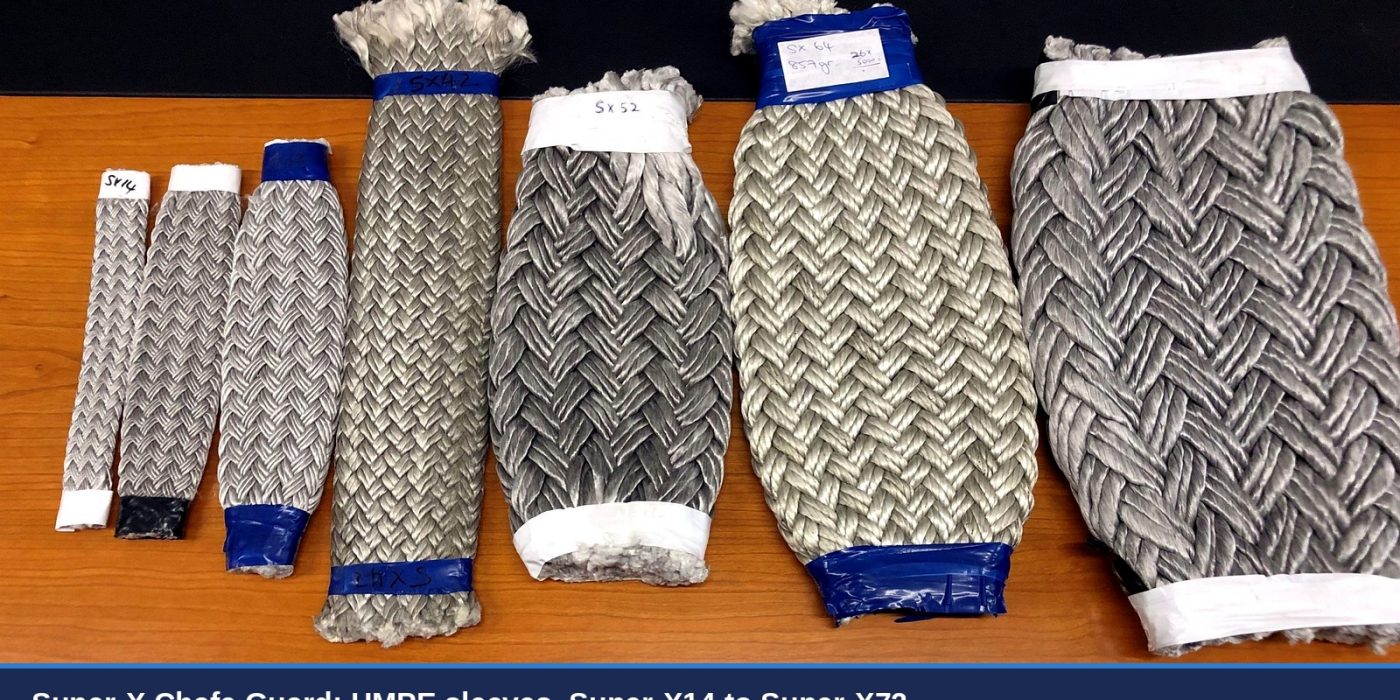
Super-X is our HMPE braided tubular sleeve for protecting ropes and slings from cutting, abrasion and wear.[2] The data sheet lists these features:
- HMPE braided tubular construction
- Floats and does not absorb water
- Cut resistant, with a low coefficient of friction
- UV resistant, lightweight and flexible
- Can be spliced into our braided ropes for termination
- Custom lengths and colours
It is listed for mooring lines, lifting slings, winch lines, soft shackles and outdoor applications, and comes in seven sizes from Super-X14 to Super-X72. The page gives no breaking strength, abrasion test results or temperature rating, so we size it to your rope and duty rather than to a published number. Send us the rope diameter and the job and we will confirm the right size.
How do you choose a chafe cover?
- Match the cover to the rope. The sleeve has to fit the rope diameter with room to work under load. Too tight and it will not slide on; too loose and it bunches.
- Match it to the contact surface. Rough, pitted steel needs a tougher cover than a smooth roller.
- Consider heat. Friction at a winch or bitt can heat an HMPE line. Super-12 melts at about 150 °C, so keep any heat source in mind when choosing and positioning covers.
- Decide how it stays in place. Spliced-in, stitched, taped or retained; a cover that walks off the wear zone protects nothing.
- Pick the right rope first. If chafe is your main failure mode, a jacketed rope such as Superline may suit better than a single braid plus a cover. See specifying towlines for tug and port operations.
How do you fit and inspect chafe covers?
Fit the cover so it sits over the wear zone when the line is under load, not when it is slack. Then treat it as a consumable:
- Inspect the cover before every job for cuts, glazing, flattening and displacement.
- Inspect the rope beneath it too. A cover protects the surface but also hides it. STAG lists sections of line in wear zones, particularly where they run through deck fairleads and pedestal rollers, as areas to inspect, and says routine inspection helps identify accelerating wear.[1]
- If inspection finds heavy localised abrasion, cutting or damage near the ends, a short damaged section may need to be removed from service.[1]
- Set a replacement trigger for the cover itself, as you would for the rope. STAG says the tug operator should define a line’s initial service life.[1]
Splice quality matters too: see how to splice rope. Where eyes are connected with a quick-change link, a soft shackle can protect against steel-on-rope contact.
Frequently asked questions
Do synthetic tug pennants need chafe protection?
Yes. OCIMF’s Static Towing Assembly Guidelines state that any synthetic pennant should be protected against chafing, because the pennant runs through the fairlead and is more likely to suffer wear and mechanical damage than other components.
Where should a chafe cover be fitted on a towline?
Where the rope bears on a chock, fairlead, bitt or roller, and on the eyes. STAG recommends always providing chafe protection on the individual eyes before cow-hitching. Mark the wear zone on your own towing arrangement and position the cover so it stays there under load.
What is the best material for a chafe sleeve on an HMPE line?
There is no single answer. HMPE sleeves are light, float and resist cutting, which suits HMPE lines and winch lines. Nylon, polyester and hide covers are common on other lines. Choose by the contact surface, the load, the heat you can expect and what you can inspect.
Can a chafe cover hide damage to the rope?
It can. A cover protects the surface but also hides it, so include the rope beneath the cover in your inspection routine. STAG lists sections of line in wear zones, especially at deck fairleads and rollers, as areas to inspect.
Should I fit liners or inserts to a ship’s fairlead instead?
Not without care. STAG notes that sleeves or liners fitted to fairleads can improve the contact surface but should not be fitted without a management of change process and consultation with the line manufacturer.
How often should chafe covers be replaced?
Treat them as consumables with their own inspection and replacement trigger. We do not publish a fixed interval because it depends on the duty, the contact surfaces and your towing plan. Tell us how the line is used and we will recommend a starting point.
Can Southern Ropes supply chafe covers to length and colour?
Yes. Our Super-X Chafe Guard is available in custom lengths and colours, and can be spliced into our braided ropes. Send us the rope diameter and duty for sizing.
References
- OCIMF — Static Towing Assembly Guidelines (STAG), 1st edition, April 2020: sections 2.4, 2.4.2, 2.5.1, 3.5.1, 6.3 and 6.4.3. iims.org.uk/download/203 (copy of the OCIMF STAG)
- Southern Ropes — Super-X Chafe Guard product data sheet (September 2026): HMPE braided tubular sleeve, features, applications and size range.
- Southern Ropes UK — Towing Pennants in Tug Operations, on chafe protection as a pennant specification. southernropes.co.uk/towing-pennants-in-tug-operations
- Southern Ropes UK — Specifying Towlines for Tug and Port Operations, comparing Super 12 and Superline for chafe duty. southernropes.co.uk/specifying-towlines-for-tug-and-port-operations
Need chafe protection made to length?
Tell us the rope, the vessel and where it wears, and we will recommend the cover, the length and how to terminate it. Or use the rope finder to narrow down by sector and fibre.
Call 01489 589 333 or email [email protected]
