
Soft Shackles vs Steel Shackles for Heavy Lifting: When to Choose Each
For commercial lifting operations above 30 tonnes, the choice between a synthetic soft shackle and a steel bow shackle is rarely automatic. Both have their place. Both can be specified correctly and safely. The question is which one suits your lift, your environment, your crew and your project economics.
This guide compares HMPE soft shackles against alloy steel bow shackles across the metrics that matter to lift planners, rigging engineers and marine superintendents: weight, behaviour under load, durability, certification and total cost over a working life. It is written for buyers specifying connectors above 30 tonnes and intended as a working reference rather than an introduction.
What is the difference between a soft shackle and a steel shackle?
A steel shackle is a forged or cast metal connector, typically alloy steel, with a U-shaped or anchor-shaped bow and a pin secured by a thread, a bolt, or a bolt with cotter pin. It is rated by Working Load Limit (WLL) and remains the standard hardware for general lifting and rigging.
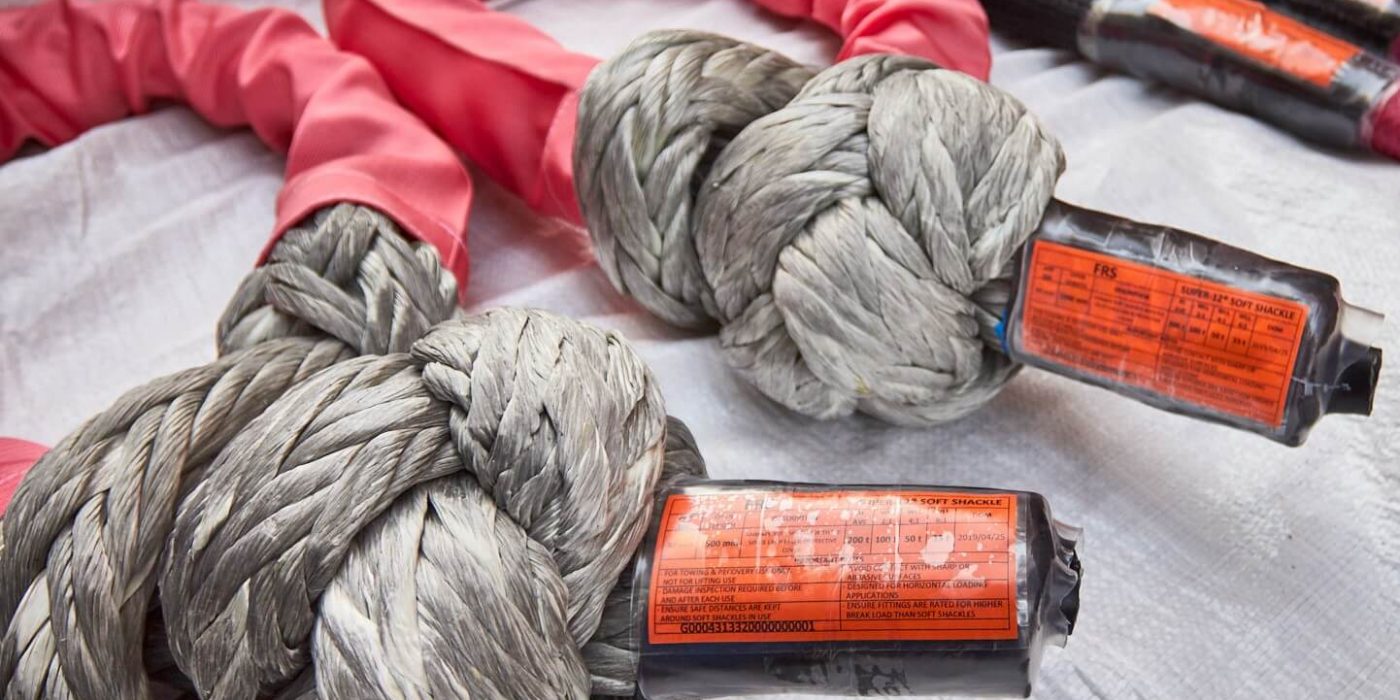
A soft shackle is a textile connector made from braided high modulus polyethylene (HMPE) fibre. The Southern Ropes UK range is manufactured from 12-strand Super-12® Stealth Fibre® and forms a closed loop, secured by a knot and matching eye. It performs the same connecting function as a steel shackle but weighs a fraction as much, will not corrode, and is rated by Minimum Break Load (MBL) with a recommended design factor applied to derive its safe working capacity.
Both serve the same purpose at the connection point. They behave very differently in service.
How much lighter is a soft shackle than a steel shackle?
The weight saving is the headline number, and at commercial tonnages it is significant.
The honest comparison applies the same design factor to both products. Southern Ropes recommends a minimum 5:1 design factor on synthetic rigging, which means a 200 tonne MBL soft shackle has a Working Load Limit of 40 tonnes. Compared against an alloy steel bow shackle of equivalent WLL, using published manufacturer catalogue weights:
| Working Load Limit | Soft shackle (HMPE) | Alloy steel bow shackle | Weight saved |
|---|---|---|---|
| 6 t | 0.10 kg | 5.31 kg | 98% |
| 14 t | 1.24 kg | 15.4 kg | 92% |
| 35 t | 6.38 kg | 23.7 kg | 73% |
| 55 t | 11.49 kg | 44.6 kg | 74% |
| 100 t | 28.61 kg | circa 204 kg | 86% |
Soft shackle weights from Southern Ropes UK product data, derated at 5:1. Steel weights from published catalogue data for alloy bow-type shackles of equivalent WLL.
The pattern holds throughout the range. A correctly rated soft shackle is between a quarter and a tenth of the weight of its steel equivalent. At the lighter end this saves crew fatigue. At the heavy end it changes the nature of the operation. A 200 kg steel shackle requires its own assist lift, a banksman and a manual handling plan to position. A 28 kg synthetic equivalent can be carried by one rigger.
Which is safer for commercial heavy lifting?
Safety considerations fall into four categories. Each needs to be assessed against the working environment, not in isolation.
Dropped object risk
A heavy steel shackle handed up to a crane hook at 80 metres is a serious DROPS hazard. The same connection made with a synthetic shackle reduces both the consequence of a drop and the likelihood of one occurring, because it can be passed up by a single rigger without slings, hook bags or assist lines.
For wind turbine maintenance, offshore platform work, ship’s mast rigging and any high-elevation lift, this is frequently the deciding factor on its own.
Behaviour at failure
When wire rope or steel rigging parts under tension, the stored elastic energy is released as recoil. The result is a whip strike capable of severe injury.
HMPE has a fibre elongation at break of only 3.5 percent. When a synthetic soft shackle fails, it does so with minimal recoil. The released energy is a fraction of the equivalent steel failure. This is one of the principal reasons offshore operators have moved towards synthetic for mooring tails and emergency towing assemblies, and it is a major argument for synthetic on any lift where personnel are in the line of force.
Sparking and chemical environments
Steel-on-steel contact generates sparks. In hydrocarbon environments, refineries, chemical terminals, ammonia plants and any area subject to ATEX classification, this is a hazard control problem that synthetic shackles remove entirely.
HMPE also offers exceptional chemical and UV resistance. In environments where steel would require coating, regular inspection for corrosion, or scheduled replacement on a short cycle, synthetic alternatives reduce the maintenance burden considerably.
Manual handling
A 55 tonne WLL steel bow shackle weighs 44.6 kg. That is well above the HSE recommended limit for single-person handling. The synthetic equivalent at 60 tonnes WLL weighs under 12 kg. Removing the two-person lift from the rigging plan reduces back injury risk, shortens rig and de-rig times, and simplifies the lift plan.
When should you choose steel over a soft shackle?
Synthetic shackles are not a universal replacement, and a guide honest enough to be useful should say so. Steel is the correct specification in the following situations.
Sharp edges or abrasive surfaces. HMPE is highly abrasion resistant for a textile, but it is still a textile. Where the shackle will repeatedly contact sharp plate, weld spatter, rusted lifting eyes or aggressive concrete, steel offers a longer service life. Protective cover braid extends the soft shackle’s tolerance but does not eliminate the constraint.
Sustained elevated temperatures. Published HMPE break loads apply at room temperature. Above approximately 70°C the fibre begins to lose strength. Foundry environments, hot work and lifts in proximity to heat sources are steel applications.
Forced side loading. A steel bow shackle accepts side loading with a published derate. A soft shackle expects to be loaded along the bight. Where rigging geometry forces a sideways pull through the knot, the soft shackle is the wrong tool.
Permanent and semi-permanent installations. Bolt-type steel shackles with cotter pins remain the standard for long-term fixed connections such as bridge tie-downs, fixed mooring points and structural pad-eye assemblies. These applications need a connector built for static service and routine inspection on a defined schedule, which steel provides.
Narrow or sharp-edged receiving fittings. Small pin holes or fittings with sharp internal radii will damage a soft shackle quickly. Either modify the fitting or specify steel.
Performance around tight radius bends
This is the comparison that surprises engineers approaching synthetic for the first time. Wire rope and chain lose strength rapidly around small-diameter fittings, with the D/d ratio becoming critical at termination points. A wire sling bent around a small pad eye is often operating well below its catalogue rating.
HMPE braided construction distributes load across twelve strands rather than concentrating it on the outer fibres of a bent wire. The soft shackle maintains high strength around tight radius bends, which makes it the better choice for lifts that wrap small fittings: compact pad eyes, narrow trunnions and the recessed lift points typical on modular cargo, machinery skids and project cargo frames.
The qualifying condition remains the same. The receiving fitting must be smooth. Edge protection forms part of the specification, not an afterthought.
Certification and what to expect from a competent supplier
Treating a synthetic shackle as a commodity item is the most common procurement mistake when transitioning from steel. A certified commercial soft shackle should arrive with:
- A certified break load tested in accordance with ISO 2307:2019
- A durable identification tag showing key technical data, with serialisation and traceability available where specified at order
- A proof load certificate where specified
- A clearly marked Working Load Limit calculated against a documented design factor (Southern Ropes recommends a minimum of 5:1)
- A specified minimum open length, which determines the shackle’s safe usable geometry in service
The minimum open length point catches buyers out frequently. A 500 tonne MBL shackle requires a minimum open length of 3 metres. Specifying the tonnage without specifying the geometry results in a shackle that is technically rated but physically the wrong shape for the lift.
If a supplier cannot provide certified break load testing or the supporting documentation a commercial lift requires, the product is not suitable for the application regardless of what is printed on its tag.
What about LOLER compliance?
Both options fall under the Lifting Operations and Lifting Equipment Regulations 1998. Synthetic shackles require thorough examination by a competent person at the same intervals as steel: every six months for equipment used in lifting persons, every twelve months for general lifting equipment, plus a fresh examination after any incident likely to have affected safety.
The inspection criteria differ. A competent person examining synthetic rigging looks for cuts, abrasion, glazing from heat exposure, discolouration from chemical contamination, inconsistent diameter, and any damage to the splices or eye terminations. Any organisation moving from steel to synthetic should ensure its inspection process and competent person are equipped to assess both.
Total cost over a working life
First cost favours steel at lower tonnages. The picture changes above 100 tonnes WLL once the following are factored in:
- Plant or assist lifts required to position heavy steel hardware on the load
- Two-person manual handling teams for shackles above HSE single lift limits
- Periodic regalvanising, thread inspection and bow distortion checks
- Insurance and DROPS exposure considerations on high-elevation work
- Scheduled replacement at end of certified service life
Synthetic shackles close the gap on first cost around 100 tonnes WLL and frequently win on total cost above 250 tonnes, particularly on projects involving repeat lifts, work at height, or marine environments. For wind farm O&M contractors, salvage operators and project cargo riggers, the operating economics increasingly favour synthetic.
Quick reference: which shackle for which lift?
| Application | Recommended |
|---|---|
| Below 25 t WLL, clean rigging environment | Either suits, specify on handling and cost |
| 25 to 100 t WLL, work at height or over water | Soft shackle |
| Above 100 t WLL, project lift or repeat lifts | Soft shackle |
| Permanent or semi-permanent installation | Steel, bolt type |
| Side-loaded rigging geometry | Steel |
| Sustained heat above 70°C | Steel |
| Repeated sharp-edge contact | Steel, or soft shackle with cover braid and edge protection |
| Hydrocarbon, chemical or ATEX environment | Soft shackle |
| High-elevation rigging | Soft shackle |
| Offshore mooring tails and tow assemblies | Soft shackle |
| Modular cargo with compact lift points | Soft shackle |
Specifying a soft shackle for your next lift?
Southern Ropes UK manufactures HMPE soft shackles from 5 tonnes to 500 tonnes MBL as standard. Certification, identification tagging, proof loading and protective cover braid are available to specification. Tell the sales team what your lift requires at the point of enquiry.
