
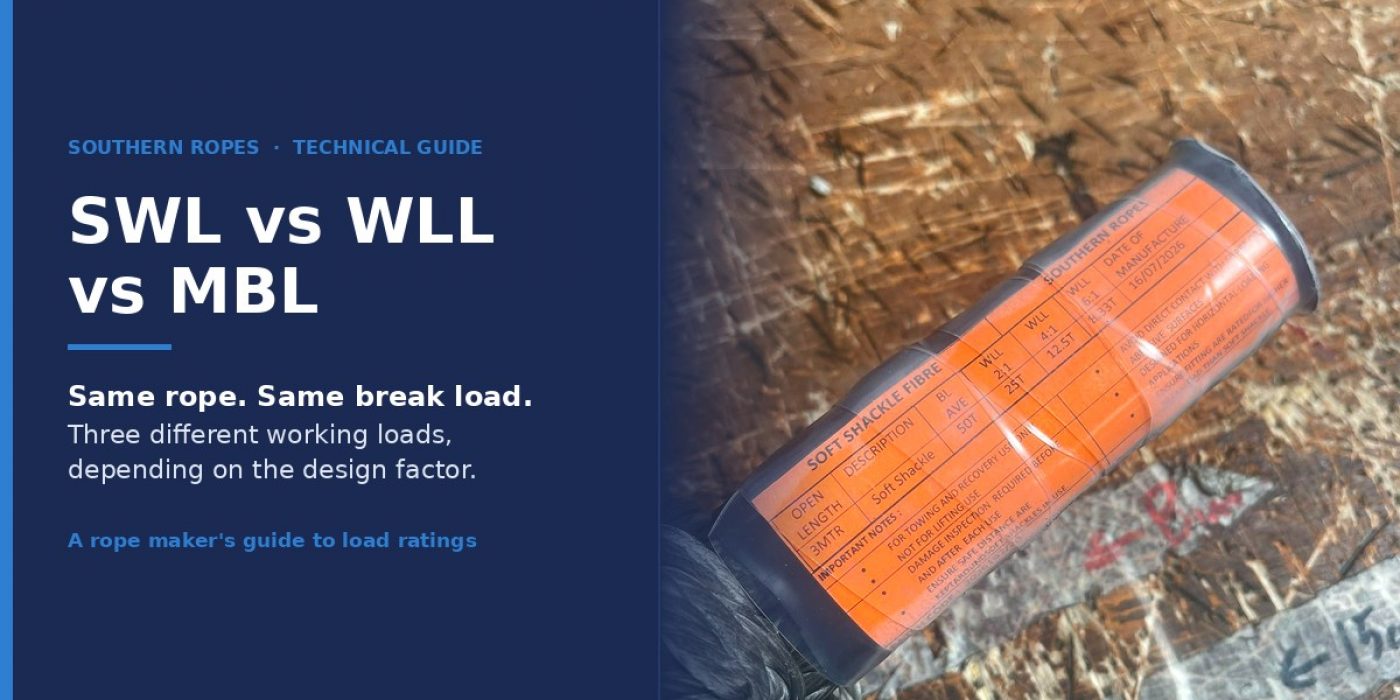
SWL vs WLL vs MBL: What’s the Difference?
Lifting / Marine / Standards / Technical guide
SWL, WLL and MBL get used as if they mean the same thing. They don’t, and the gap between them is what keeps a load in the air, a ship alongside and a technician on the wire.
Ask a room full of riggers, buyers and site managers what SWL means and you’ll hear plenty of answers that sound about right. Ask how a rope’s breaking load becomes the number people work to, and the room goes quiet. As a rope maker, MBL is the number we work with every day, so this guide sets out what each rating means, how the three connect, and what factor applies in your application, whether that’s a lifting or towing rope, a mooring line or a rope access line.
The short answer. MBL (minimum breaking load) is the lowest force at which new rope should break. WLL (working load limit) is the maximum load a manufacturer rates a finished product to carry, calculated by dividing breaking strength by a design factor. SWL (safe working load) is the term used in UK lifting law, and a competent person can set it below the WLL for a specific job. MBL is always the biggest number, and never the one you work to.
What is the difference between SWL, WLL and MBL?
| Term | What it tells you | Who sets it | Where you find it |
|---|---|---|---|
| MBL Minimum breaking load |
The lowest force at which new rope should break | Rope manufacturer, from testing | Rope specifications and test certificates |
| WLL Working load limit |
The maximum load the finished product is rated to take in normal service | Manufacturer of the finished item, or the system designer | Product tag or label; certificate; mooring or towing plan |
| SWL Safe working load |
The maximum load for a specific use, equal to or below the WLL | Matches the WLL unless a competent person lowers it | Equipment marking; thorough examination report |
What does MBL mean on a rope?
MBL is the lowest force at which new, unused rope of a given material, construction and diameter should break under a steady pull. Fibre rope breaking force is measured using the method set out in ISO 2307.[1] This is the one rating that applies to every rope, whatever it’s used for. Before relying on any MBL figure, check three things.
Minimum, not average. Some catalogues quote a typical breaking load, which is always higher. Compare minimum with minimum.
Spliced or unspliced. A splice reduces strength at that point, so check how the figure was tested. Our guide on how to splice rope explains why. It matters commercially too: mooring lines are specified on spliced strength, while most catalogue MBLs are unspliced.
Kilonewtons or kilograms. One tonne of force is about 9.81 kN, so a rope with a 34.3 kN MBL breaks at roughly 3,500 kg. Mix the units up and you’re out by a factor of ten.
What does WLL mean?
The Lifting Equipment Engineers Association (LEEA) defines WLL as the maximum mass an item of lifting equipment is designed to raise, lower or suspend.[2] The term is used well beyond lifting: mooring guidance sets a WLL for mooring lines too. In every case it belongs to the finished product or the designed system, not to rope on a reel.
It also assumes normal use. A lifting sling’s WLL applies to a straight, vertical lift; choke it or angle the legs and the capacity changes. A mooring line’s WLL assumes the line runs as designed, not around a sharp chock.
What does SWL mean, and is it still used in the UK?
Yes, SWL is still in use. You’ll read online that WLL has replaced SWL and that SWL no longer counts. That’s only half right. Product standards now use WLL, but the Lifting Operations and Lifting Equipment Regulations 1998 (LOLER) still require accessories for lifting to be clearly marked with their safe working loads, and every report of thorough examination must record the SWL.[3]
LEEA’s Code of Practice for the Safe Use of Lifting Equipment treats SWL as a figure for a specific application.[2] In normal service it equals the WLL. Where a job carries extra risk, such as extreme temperatures, chemical exposure or harsh commercial marine conditions, a competent person can set it lower. It can never be set higher.
How is a working load calculated from MBL?
Working load = breaking strength of the finished item ÷ design factor
In lifting, that divisor is called the coefficient of utilisation. Elsewhere it’s a design factor or, informally, the safety factor. Whatever the name, it does the same job: it absorbs what a laboratory test on new rope can’t see, including wear, dynamic loading, imperfect rigging and site conditions.
The critical point is that the number is not universal. It is set by the application, by the standard that governs it, and sometimes by the supplier. Lifting is the most tightly controlled; elsewhere the margins are set by industry guidance or engineering judgement.
What design factor applies to my application?
| Demande | How the working load is set | Governed by |
|---|---|---|
| Fibre rope lifting slings | Coefficient of utilisation of 7, then adjusted by the hitch or number of legs | BS EN 1492-4; ISO 18264 for HMPE[4] |
| Webbing slings and roundslings | Coefficient of utilisation of 7 | BS EN 1492-1 and 1492-2[4] |
| Wire rope and chain slings | 5 for wire rope, 4 for grade 8 chain | BS EN 13414-1; BS EN 818-4[4] |
| Ship mooring lines | Lines specified at 100 to 105% of the ship design MBL; WLL set at 50% of ship design MBL for synthetic lines and 55% for steel wire | OCIMF MEG4[5] |
| Towlines and towing pennants | Sized from the tug’s bollard pull, with the multiple set by the towing plan, class rules or the warranty surveyor | Towing plan and operator procedures |
| Rope access and work at height | No WLL. Ropes are type-approved on fall performance, elongation and termination strength, and used within a designed system | BS EN 1891 (PPE)[6] |
| General rigging, winching and utility | No single legal factor. Catalogue “working loads” rest on a factor the supplier chose, so ask which one | Supplier or engineer’s judgement |
The trap. A factor of 7 is not a universal rule of thumb. Applying a lifting coefficient to a mooring line oversizes it to the point where the rope stops being the weakest part of the system and something less forgiving breaks instead. Applying a mooring percentage to a lifting sling is dangerous and illegal. Use the factor that belongs to the application.
Worked example: how does a rope’s MBL become a sling’s WLL?
Lifting shows the full calculation most clearly. This example follows a single-leg fibre rope sling made to BS EN 1492-4. The figures are illustrative: the real WLL of any sling is set, marked and certified by its manufacturer.
| Step | Calculation | Result |
|---|---|---|
| Rope’s certified MBL (unspliced) | From the rope certificate | 3,500 kg |
| Allow for the spliced eyes | × 0.9 (typical splice allowance) | 3,150 kg |
| Apply the coefficient of utilisation | ÷ 7 | 450 kg WLL, straight lift |
| Used in a choke hitch | × 0.8 mode factor | 360 kg |
| Made up as a two-leg sling, legs up to 45° from vertical | × 1.4 mode factor | 630 kg |
Look at the gap. Rope that breaks at 3,500 kg lifts 450 kg straight and 360 kg choked. That margin absorbs the snatched load, the worn patch and the edge nobody spotted. Always work from the manufacturer’s information for the item in front of you, and never use a multi-leg sling with its legs more than 60° from vertical.
Can you work out a safe working load from a rope’s MBL yourself?
For lifting, no. A reel of rope has an MBL but no WLL. It only earns one when a competent manufacturer has made it into an accessory, tested and marked it, and issued a declaration of conformity under the Supply of Machinery (Safety) Regulations 2008.[7] Lifting on rope straight off the reel puts you outside the standards and on the wrong side of LOLER and its Approved Code of Practice.[8]
For work at height the answer is also no, and for a different reason. Rope access lines aren’t rated with a working load at all. Ropes such as Response LSK are certified against fall performance and termination strength under BS EN 1891, and the margin lives in the design of the whole system: anchors, back-up, and the forces a fall can generate.[6] Dividing an MBL by a number tells you nothing useful there.
For mooring, towing and general rigging, you can apply a factor, but it has to be the right one for the job and it should come from the governing guidance or an engineer, not from habit.
What reduces a fibre rope’s strength in service?
MBL is measured on new rope in a test house. Real work is less polite, and this applies to every rope regardless of what it’s doing.
| Facteur | What to know |
|---|---|
| Knots | Significantly reduce strength. Textile slings must not contain knots, connections or splices other than at their ends.[9] |
| Tight bends | Rope loaded over a small hook, pin, chock or edge is weaker at the bend. |
| Heat | BS EN 1492-4 slings: polyester and polyamide from -40°C to 100°C; polypropylene and natural fibres from -40°C to 80°C.[4] Friction heat on winches and chocks does damage too. |
| Chemicals | Polyester is damaged by alkalis, polyamide by acids. Match the fibre to the environment. |
| Water | Polyamide (nylon) loses strength when wet, which is why mooring guidance requires it to be tested wet. Polyester does not. |
| UV | Degrades synthetic fibre over time, polypropylene most of all. |
| Shock loading | A snatched load, a surging vessel or an arrested fall applies far more force than static weight. |
| Creep | HMPE ropes such as Super-12® stretch slowly under a sustained load. |
| Wear and age | Abrasion and grit reduce strength over time. Lifting accessories need a thorough examination at least every six months, and equipment used to lift people needs the same.[10] |
What should you ask your rope supplier?
Whatever the rope is for, the number you end up working to is only as good as the MBL you started with. Before a reel leaves the shelf, confirm that the MBL is a certified minimum rather than a typical value, how it was tested and whether the samples were spliced, that the batch is traceable through documentation such as an EN 10204 inspection certificate, and that the rope meets its material standard: ISO 1141 for polyester, ISO 1140 for polyamide, ISO 1346 for polypropylene or ISO 10325 for HMPE.[11] If the rope is destined for lifting, mooring or work at height, also confirm that its construction falls within the scope of the standard you’re working to.
Foire aux questions
What is the safety factor for polyester lifting slings?
Webbing slings, roundslings and fibre rope slings made to BS EN 1492 parts 1, 2 and 4 use a coefficient of utilisation of 7, so their breaking strength is at least seven times the WLL. That figure applies to lifting slings, not to rope in other applications.
Is there a standard safety factor for rope?
No. The factor depends on the application and the standard that governs it. Lifting slings use a coefficient of utilisation fixed by the product standard, mooring lines are sized as a percentage of the ship design MBL, towlines are sized from bollard pull, and rope access lines aren’t given a working load at all.
What is the working load limit of a mooring line?
Under OCIMF MEG4, the WLL is a percentage of the ship design MBL: 50% for synthetic lines and 55% for steel wire. New lines should have a design break force of 100 to 105% of the ship design MBL, tested spliced.
Do rope access ropes have an SWL?
No. Low stretch kernmantel ropes to BS EN 1891 are personal protective equipment, certified on fall performance, elongation and termination strength rather than a working load. Safety comes from the designed system and the user’s training, not from dividing an MBL.
Is MBL the same as breaking strain?
Breaking strain is an older, informal term. MBL is more precise: it is the guaranteed minimum for new rope, not a typical value.
Does a rope’s MBL reduce over time?
The published figure stays the same, but the rope’s real strength does not. Wear, UV, heat, chemicals and shock loads all reduce it, which is why pre-use checks and regular inspection matter.
Specifying rope? Start with an MBL you can trust.
Southern Ropes UK supplies polyester, polyamide, polypropylene and HMPE rope for lifting, mooring, towing, rope access and industrial use. Tell us the application, fibre, construction, diameter and quantity, or use the rope finder to narrow things down.
Appelez le 01489 589 333 ou envoyez un e-mail à [email protected]
References
- ISO 2307:2019, Fibre ropes: Determination of certain physical and mechanical properties. International Organization for Standardization. iso.org
- Lifting Equipment Engineers Association, FAQs, citing definitions from LEEA’s Code of Practice for the Safe Use of Lifting Equipment (COPSULE). leeaint.com
- The Lifting Operations and Lifting Equipment Regulations 1998 (SI 1998/2307), regulation 7 (marking of lifting equipment) and Schedule 1 (information to be contained in a report of thorough examination). legislation.gov.uk
- British Standards Institution: BS EN 818-4 (grade 8 chain slings); BS EN 13414-1 (steel wire rope slings); BS EN 1492-1 (flat woven webbing slings); BS EN 1492-2 (roundslings); BS EN 1492-4 (lifting slings made from natural and man-made fibre ropes). Also ISO 18264:2022, Textile slings: lifting slings for general purpose lifting operations made from fibre ropes. High modulus polyethylene (HMPE). iso.org
- Oil Companies International Marine Forum, Mooring Equipment Guidelines, fourth edition (MEG4, 2018), covering ship design MBL, line design break force and working load limit. ocimf.org
- BS EN 1891, Personal protective equipment for the prevention of falls from a height: low stretch kernmantel ropes, covering type A and type B ropes from 8.5 mm to 16 mm.
- The Supply of Machinery (Safety) Regulations 2008 (SI 2008/1597), implementing Directive 2006/42/EC. legislation.gov.uk
- Health and Safety Executive, L113: Safe use of lifting equipment. Lifting Operations and Lifting Equipment Regulations 1998. Approved Code of Practice and guidance (2nd edition, 2014, amended 2018). hse.gov.uk
- Safety Assessment Federation (SAFed), Guidance on the Thorough Examination of Textile Slings, quoting the Machinery Directive 2006/42/EC, Annex I requirements for textile ropes and slings. safed.co.uk
- The Lifting Operations and Lifting Equipment Regulations 1998 (SI 1998/2307), regulation 9 (thorough examination and inspection). legislation.gov.uk
- Fibre rope material standards: ISO 1141 (polyester), ISO 1140 (polyamide), ISO 1346 (polypropylene) and ISO 10325 (HMPE). Inspection documents: BS EN 10204.
Important: This article is general guidance on load rating terminology. It does not replace the relevant standards, the manufacturer’s instructions for a specific product, a lift or mooring plan, or the judgement of a competent person. A rope’s minimum breaking load is not a working load. Lifting accessories must be made, marked and certified by a competent manufacturer and thoroughly examined in accordance with LOLER 1998. Equipment for work at height must be selected, used and inspected in accordance with the Work at Height Regulations 2005 and the manufacturer’s instructions.
Super-12® is a registered trademark of Southern Ropes. Dyneema® is a registered trademark of Avient Protective Materials B.V. All other trademarks are the property of their respective owners.
