At Southern Ropes, every rope we produce tells a story of precision, performance, and people.
From a single pellet of polymer to the finished rope shipped to our customers around the world, each stage of the process is built on care, technology, and decades of experience.

The journey begins with science.
We start with tiny polymer pellets, usually polypropylene or polyethylene which are carefully melted and extruded in our Cape Town factory. This process turns raw polymers into continuous, ultra-fine synthetic filaments, the building blocks of every Southern Ropes product.
As the molten material exits the die, it is cooled, stretched, and drawn under controlled tension to align the molecules and increase tensile strength. This alignment gives each fibre its characteristic combination of light weight, strength, and flexibility.
Unlike most rope companies, we extrude our own yarns on site. This gives us complete control over quality, colour, and material properties ensuring our ropes perform consistently from the molecular level up.
When these filaments are cooled, wound, and collected on bobbins, we have the perfect starting point: strong, uniform fibres ready to be spun into strands.
Next, our extruded fibres are grouped and spun into yarns, then combined to form strands.
Each strand can contain dozens or even hundreds of filaments, twisted together with meticulous precision.
This step is where the rope’s internal balance is set.
For traditional constructions, these strands are used to make laid ropes (three or four-strand ropes). For high performance lines, the strands become input for the next stage: braiding.

Here is where the art truly begins.
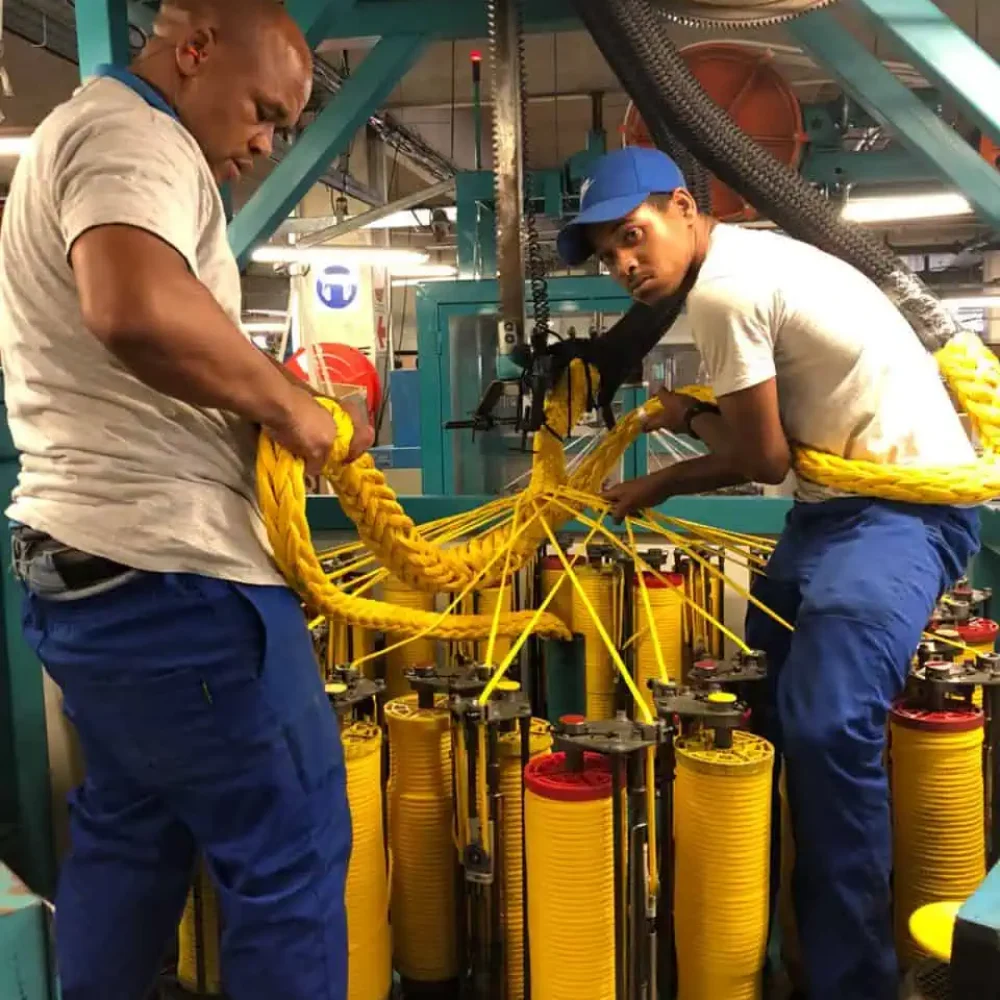
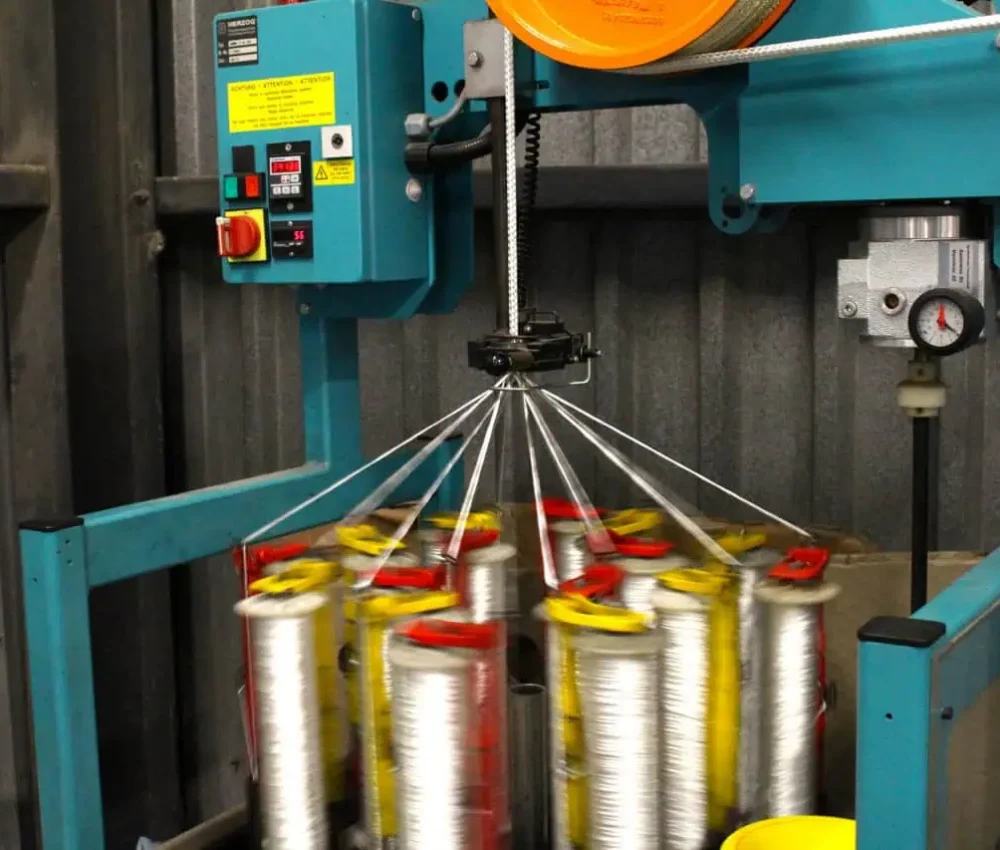
Southern Ropes uses a range of Herzog braiding machines imported from Germany precision-built systems that interlace yarns and strands in perfect sequence. Each machine’s bobbins dance in a carefully timed pattern, weaving multiple strands into a single, seamless rope.
For smaller diameters, this produces fine braided cords used in climbing, safety, or yacht lines. For heavy industrial ropes, the process scales up dramatically.
Our largest machine Big Bertha stands over 9 metres tall and can braid ropes up to 160 mm in diameter. It’s a feat of engineering rarely seen anywhere in the world. Big Bertha works by braiding smaller pre-made ropes together in stages, layering strength until a single massive rope emerges each layer perfectly tensioned and aligned.
Whether 6 mm or 160 mm, every rope leaves the braider perfectly round, balanced, and built for strength.
Once braided or twisted, the rope isn’t finished yet. It now undergoes a series of finishing treatments that enhance its performance.
These steps ensure that each rope not only looks flawless but also performs reliably for years in harsh marine, industrial, or rescue environments.


Every Southern Ropes product is tested to its limits before it ever leaves the factory.
Our ISO 9001:2015-certified testing facility includes a 300-tonne horizontal test bed, capable of performing break, proof, and fatigue tests.
Each rope is pulled, stretched, and measured against stringent British (BS), European (EN), and SABS standards.
Data from each test is logged and certified so when you receive a rope from us, its performance isn’t claimed, it’s proven.
We test for:
Nothing leaves our facility without meeting the Southern Ropes standard: Trusted Strength. Proven Performance.
The final stage brings craftsmanship back to centre stage.
Our riggers hand splice eyes, loops, and terminations, fit hardware like thimbles or shackles, and add protective sleeves where needed. Each splice is inspected and tested for full load security.
Once complete, the ropes are coiled, labelled, and prepared for shipment whether to a local dockyard, an offshore platform, a climbing supplier, or a rescue service halfway across the world.
Every rope leaves our warehouse with the same promise:
Built with care, tested with precision, and ready to perform when it matters most.

Southern Ropes works with an extensive range of fibres, extruding many of them in‑house. Each material has unique properties suited to different applications.
Stealth Fibre® is a next generation HMPE (High Modulus Polyethylene) fibre offering an ultra high strength to weight ratio. Ideal where maximum performance and low weight are critical.
A highly elastic fibre with excellent energy absorption characteristics. Nylon Rope is weaker when wet and can stiffen up when exposed to salt water.
Polyester Rope is a high-tenacity thermoplastic fibre that provides great all-round performance and durability, with an excellent price for performance ratio.
A general-purpose, floating fibre consisting of fine filaments as opposed to conventional monofilament or split film polypropylene.
Polysteel Rope is a high tenacity composite fibre made from polypropylene and polyethylene. Highly resistant to abrasion, chemicals, and UV.
Polyrene is a blend of fibres that exhibits good abrasion resistance and has been specifically developed as an alternative to nylon. It has the same weight as nylon but does not lose strength when wet.
Zylon® is one of the world’s strongest synthetic fibres. It offers exceptional tensile strength, minimal elongation, and outstanding thermal stability up to 650°C.
Vectran™ e is spun from liquid crystal polymer (LCP) fibres, offering high strength, minimal creep, and excellent resistance to abrasion and flex fatigue. It maintains stability under load and temperature variation
A highly elastic fibre with excellent energy absorption characteristics. Nylon Rope is weaker when wet and can stiffen up when exposed to salt water.
Polyester Rope is a high-tenacity thermoplastic fibre that provides great all-round performance and durability, with an excellent price-for-performance ratio.
A general-purpose, floating fibre consisting of fine filaments as opposed to conventional monofilament or split-film polypropylene.
Polyrene Rope is a blend of fibres that exhibits good abrasion resistance and has been specifically developed as an alternative to nylon. It has the same weight as nylon but does not lose strength when wet.
Our rope finder tool enables you to choose and get a quote on rope depending on usage, fibre and dimensions required.

