
Mooring Tails Explained: Materials, Length, MBL & When They’re Required
Mooring / Commercial marine / Technical guide
A mooring tail is the short, elastic length spliced between a stiff mooring line and the ship — and on most tankers it isn’t optional. Here’s what it does, how it’s sized, and when OCIMF rules make it a requirement rather than a choice.
Technical figures in this guide are drawn from OCIMF’s Mooring Equipment Guidelines (MEG4) and published manufacturer technical guidance — see references below.
What is a mooring tail?
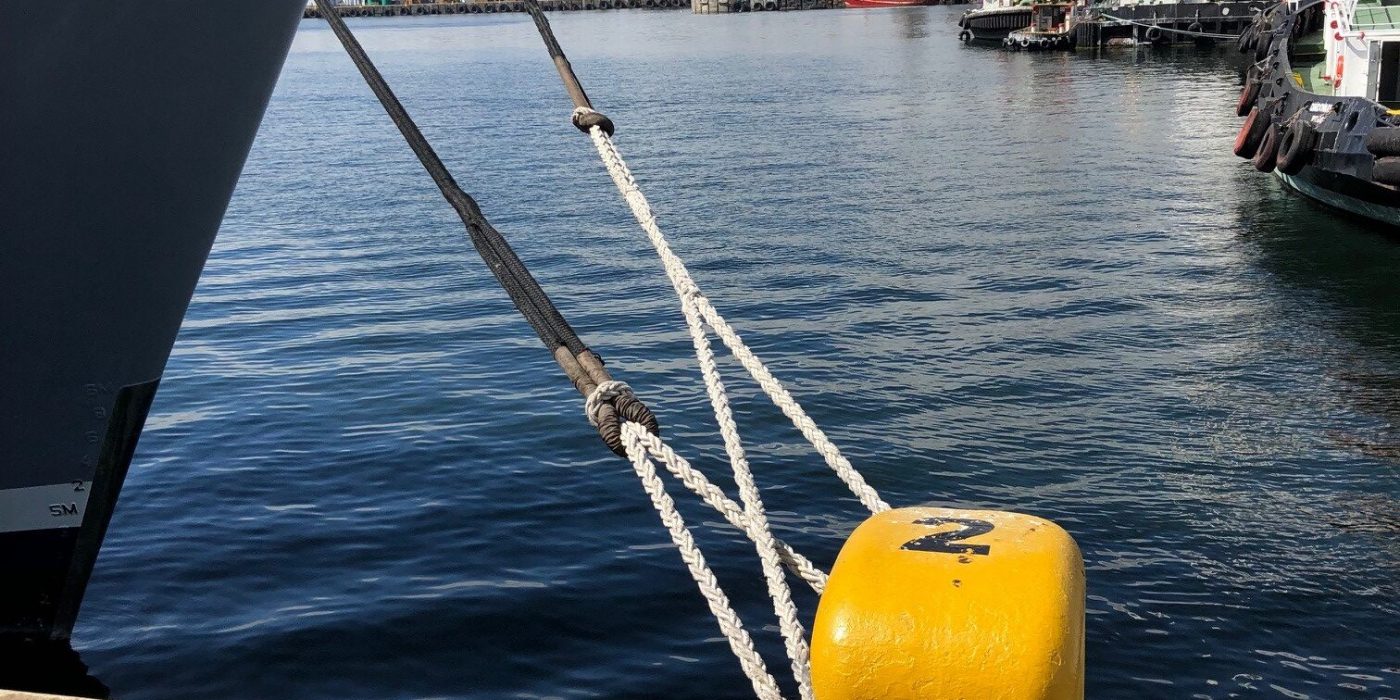
A mooring tail is a short, high-elongation rope spliced or connected between the ship’s main mooring line — often HMPE or steel wire, both very low-stretch — and the shore bollard or buoy. Its job is to absorb the shock loading that a low-stretch line can’t: surge, swell and passing-vessel wash all put sudden peaks into a mooring, and the tail’s elasticity smooths those peaks out before they reach the winch, fairlead and deck fittings.
What material should a mooring tail be?
Tails are built from moderate-to-high elasticity fibres, not the low-stretch fibres used on the main line — the whole point is the stretch. Polyester is a common choice: good elasticity, strong abrasion and UV resistance, and it retains strength when wet. Nylon offers even higher elongation — around 30% at break — but loses roughly 10–15% of its dry strength when wet, which has to be accounted for in the specification. Polyester/polyolefin composite constructions are also used, combining elasticity with a lighter, more buoyant tail.
How long should a mooring tail be?
The industry standard overall length is 11 metres, though exposed berths with heavier surge often call for a longer tail to give the elasticity more length to work with.[2] Length should always be matched to berth conditions, not assumed from a default — check the terminal’s own requirements before ordering.
Mooring tail strength: how MBL is calculated under MEG4
OCIMF’s Mooring Equipment Guidelines, Fourth Edition (MEG4) set out the reference framework nearly every tanker and terminal now specifies against.[1] The starting point is the vessel’s Ship Design MBL (MBLsd) — the minimum breaking load the ship’s mooring system was designed around. Every other figure is calculated relative to it:
| Term | Meaning | MEG4 value |
|---|---|---|
| MBLsd | Ship Design MBL — the vessel’s own reference figure | Set by ship design |
| LDBF | Line Design Break Force — the main mooring line’s tested break force | 100–105% of MBLsd |
| TDBF | Tail Design Break Force — the tail’s tested break force, wet | 125–130% of MBLsd |
| WLL | Working Load Limit — the typical safe operating load | 50% of line strength (synthetics) |
Sources: OCIMF MEG4 [1]; manufacturer technical guidance [2],[3]
The tail is deliberately specified stronger than the line it protects — 125–130% of MBLsd, tested wet, since a wet tail is what it will be in service. That margin exists because the tail is absorbing shock the main line was never designed to take directly; if it were the same strength as the line, it would offer no protection at all.
When is a mooring tail required?
Tails are effectively mandatory wherever a ship is moored on a low-stretch main line — HMPE or wire — at a berth exposed to any meaningful surge, which in practice means most tanker and product terminals. Many oil major terminals will not accept a vessel alongside without a certified tail meeting MEG4 criteria; it’s frequently a condition of berth acceptance, not a recommendation. Vessels moored entirely on higher-stretch lines such as nylon or polyester sometimes operate without a separate tail, since the line itself provides some shock absorption — but this should be confirmed against the specific terminal’s mooring requirements rather than assumed.
When to retire a mooring tail
OCIMF MEG4 guidance recommends retiring a tail once residual strength falls to 75% of the ship design MBL.[2],[4] In practice that means regular inspection for abrasion, chafe, dirt and salt contamination, and correct storage between uses — a tail left coiled wet and salt-loaded degrades faster than one properly dried and stowed. Discard criteria should be built into the vessel’s Mooring System Management Plan, not judged case by case at the point of use.
Match the tail to the line, not just the berth. A tail’s TDBF is calculated against ship design MBL — not against whatever line happens to be on the drum. Specifying a tail without reference to the vessel’s actual MBLsd is the most common error terminal superintendents report, and it’s an easy one to avoid with the right paperwork at order stage.
Häufig gestellte Fragen
What is the standard length of a mooring tail?
11 metres is the standard recommended overall length. Exposed berths with heavier surge often require a longer tail.
What material is best for a mooring tail?
Polyester is the most common choice for its balance of elasticity, abrasion resistance and wet strength retention. Nylon offers higher elongation but loses 10–15% of its dry strength when wet, which must be factored into the specification.
How strong should a mooring tail be compared to the main line?
Under OCIMF MEG4, a tail’s Tail Design Break Force should be 125–130% of the vessel’s Ship Design MBL, tested wet — deliberately stronger than the main line’s Line Design Break Force, which sits at 100–105% of the same reference figure.
Do all vessels need a mooring tail?
Any vessel moored on a low-stretch main line, such as HMPE or wire, at a berth with meaningful surge effectively needs one — and many tanker terminals make a certified MEG4-compliant tail a condition of berth acceptance. Always confirm against the specific terminal’s requirements.
When should a mooring tail be retired?
OCIMF MEG4 recommends retirement once residual strength falls to 75% of the ship design MBL, assessed through regular inspection for abrasion, chafe and contamination as part of the vessel’s Mooring System Management Plan.
References
- OCIMF — Mooring Equipment Guidelines, Fourth Edition (MEG4). ocimf.org/publications/books/mooring-equipment-guidelines-meg4
- Katradis Group — User’s Manual: Synthetic Mooring Tails. katradis.com — User’s Manual, Synthetic Mooring Tails
- Samson Rope — MEG4 Compliance Customer Information and Resolving MEG4 Confusion. samsonrope.com — MEG4 Compliance Customer Information
- Wilhelmsen Ships Service — Mooring Tail Guidelines: Ropes Retirement Criteria. wilhelmsen.com — Ropes Retirement Guidelines, Tails
Figures cited follow OCIMF MEG4 terminology and published manufacturer technical guidance current at the time of writing. Always confirm current requirements against your vessel’s own Mooring System Management Plan and the specific terminal’s berth requirements before specifying or ordering.
Need mooring tails specified to your vessel’s MBL?
Southern Ropes UK supplies certified mooring tails and mooring lines for commercial marine operators, spliced and tested to MEG4 requirements with full documentation. Tell us your vessel’s ship design MBL and berth conditions and we’ll specify the right tail.
Rufen Sie unter 01489 589 333 an oder senden Sie eine E-Mail an [email protected]
